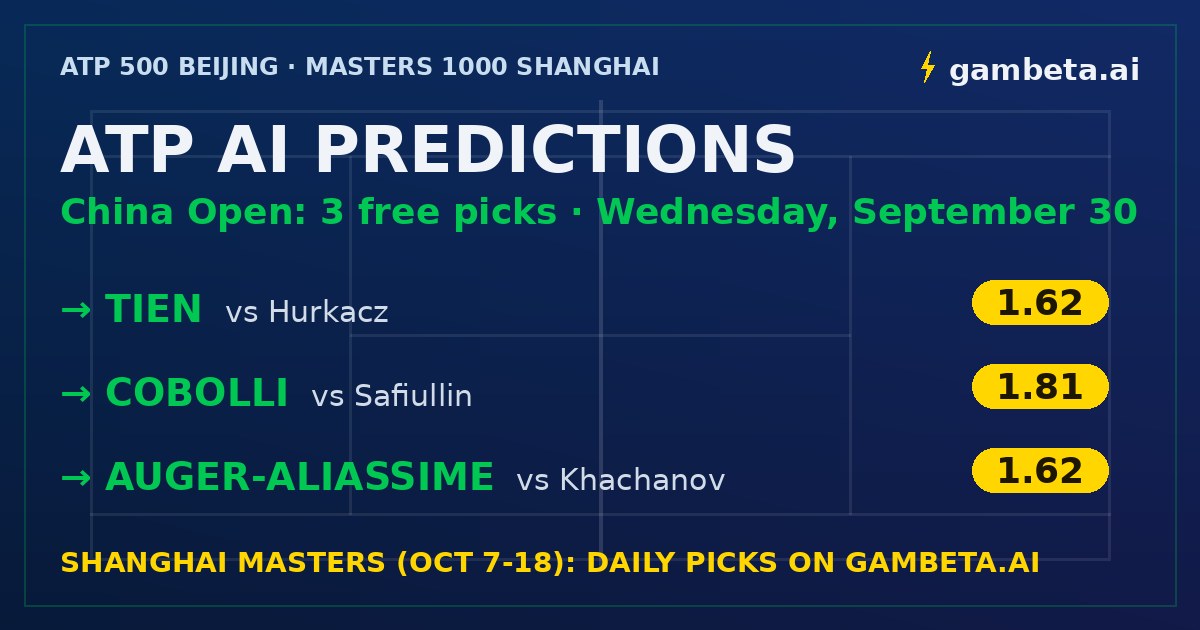
The AI's three free picks for the start of the China Open, with the odds at publication.
The China Open AI predictions at a glance
The 2026 China Open main draw starts on Wednesday, September 30 in Beijing, and Gambeta's artificial intelligence has already published its three free picks for the first round. In all three matches it backs the seeded player, in other words the higher-ranked one. Here is the summary of the ATP Beijing AI predictions:
| Match | Pick | Odds | Confidence | Time (UTC) |
|---|---|---|---|---|
| Hurkacz vs Tien | Tien to win | 1.62 | Medium-High | Wed 30 · 02:00 |
| Cobolli vs Safiullin | Cobolli to win | 1.81 | Medium-High | Wed 30 · 02:00 |
| Auger-Aliassime vs Khachanov | Auger-Aliassime to win | 1.62 | Medium-High | Wed 30 · 02:00 |
The odds are the ones at the time the pick was published and may move before the match. The time is the reference slot the AI loaded for the day (10:00 in Beijing), but according to the ATP, Wednesday's play starts at 11:00 local time (03:00 UTC) and matches follow one another on each court, so the real start can slip quite a bit. Check the order of play before you bet. In other time zones, the reference time is 03:00 Wednesday in the UK, 22:00 Tuesday on the US East Coast and 19:00 Tuesday on the West Coast.
China Open 2026: what's at stake in Beijing
The China Open is an ATP 500 hard-court event played at the National Tennis Center in Beijing since 1993. The 2026 edition runs from September 30 to October 6, with a 32-player draw and total prize money of US$4,089,385, according to the ATP. It is the warm-up for the Shanghai Masters and shares the week with the ATP 500 in Tokyo, where Carlos Alcaraz leads the field.
The defending champion is missing. Jannik Sinner, who won in 2025 by beating Learner Tien 6-2, 6-2 in the final, withdrew with the knee injury that had already kept him out of the US Open. Without him, the top seed is Alexander Zverev, who opens against Cameron Norrie, and the headline story is Novak Djokovic's return to Beijing after eleven years: he won all six editions he played, with a perfect 29-0 record. The Serbian opens against Nuno Borges and sits in the same quarter as Zverev, so they could meet in the quarter-finals.
The other seeds mentioned in this article are Felix Auger-Aliassime (2), Flavio Cobolli (4), Alex de Minaur (5) and Learner Tien (7). Three of them start on Wednesday, and the AI has a pick in all three of those matches.
Hurkacz vs Tien: AI prediction, Tien to win (1.62)
Tien, the No. 7 seed and last year's runner-up, is the AI's pick at 1.62.
This is one of the best first-round matches. Learner Tien is the seventh seed and knows these courts well: last year he reached the Beijing final, where he lost to Sinner. Across the net is Hubert Hurkacz, a former top-10 player who has just played the final of the ATP 250 in Chengdu, his first final of the season after a year disrupted by a long-term injury. He lost it to Alejandro Davidovich Fokina 6-4, 7-6, failing to convert four set points in the tie-break.
The AI backs Tien at 1.62, which works out to an implied probability of about 62%. Working in his favour are the ranking and his record on these very courts; the risk is Hurkacz's serve, which on a hard court can drag the match into tie-breaks where anything can happen. Both also arrive with little rest: Tien played the Laver Cup in London from September 25 to 27, where he beat Cobolli 6-3, 2-6, 10-7, and Hurkacz is coming off a full week in Chengdu. The AI's verdict is Tien to win. The full breakdown is in the Hurkacz vs Tien preview.
Cobolli vs Safiullin: AI prediction, Cobolli to win (1.81)
The best-paying pick of the three: Cobolli to win his opener at 1.81.
Flavio Cobolli is the tournament's fourth seed and opens against Russia's Roman Safiullin, who is unseeded. If the Italian gets through, fifth seed Alex de Minaur is a possible quarter-final opponent in his section of the draw.
It is the best-paying pick of the three and, for the same reason, the riskiest: odds of 1.81 equal an implied probability of about 55%, only just better than a coin flip. The AI publishes it because the ranking gap is big enough to make Cobolli the favourite, but not big enough to push the odds down. Cobolli is also coming from London: he played the Laver Cup for Team Europe, where he lost precisely to Tien. The Cobolli vs Safiullin prediction is a straight win for the Italian. The analysis is in the Cobolli vs Safiullin preview.
Auger-Aliassime vs Khachanov: AI prediction, Auger-Aliassime to win (1.62)
The No. 2 seed against the man who knocked him out of the US Open: the AI still picks him at 1.62.
The second seed has the trickiest opener. Felix Auger-Aliassime faces Karen Khachanov, who beat him less than a month ago in the second round of the US Open 6-7, 6-3, 6-2, 6-2 and then went on to reach the semi-finals. That match comes with context: the Canadian said he started feeling unwell midway through the second set, and he finished with 47 unforced errors to the Russian's 30.
The AI still sides with Auger-Aliassime at 1.62 (around 62% implied), on ranking and seeding. This is the pick with the most revenge in the air: if Khachanov repeats his New York level, the Canadian's price looks short. That makes it the match where sticking to a flat stake matters most. The AI's verdict is Auger-Aliassime to win, and the full case is in the Auger-Aliassime vs Khachanov preview.
The AI's Beijing parlay: odds of 4.75
If you combine the three free picks, the odds are 1.62 × 1.81 × 1.62 = 4.75. Using the implied probability of each price, the chance of all three landing is around 21%: one in five. That is a high-priced bet, so if you play it, keep the stake small; the picks are designed to be played one at a time. To learn how to build parlays sensibly, read the guide to AI parlay betting.
Shanghai Masters 2026: dates and how to follow the AI picks
As soon as Beijing ends, the Asian swing's main event arrives: the Rolex Shanghai Masters, an ATP Masters 1000 on hard courts played from October 7 to 18, 2026 at the Qizhong Forest Sports City Arena. It lasts twelve days with a 96-player draw, so the early rounds bring dozens of matches a day.
The defending champion is Valentin Vacherot, author of one of the strangest stories on tour: in 2025 he came through qualifying ranked No. 204 in the world, beat Djokovic in the semi-finals and in the final defeated his cousin, Arthur Rinderknech, 4-6, 6-3, 6-3. No Masters 1000 champion had ever been ranked that low. The entry list published by the tournament for 2026 includes Sinner, Alcaraz, Zverev, Djokovic (Shanghai's record champion with four titles), Auger-Aliassime and De Minaur, among others. With Sinner, though, it is wait and see: he pulled out of Beijing with his knee, and his participation depends on how it responds.
How do you follow the Shanghai Masters AI predictions? Throughout the tournament, Gambeta's AI will publish its picks day by day on the Gambeta homepage, in the 🎾 Gambeta Tennis tab, before each match and with its odds and probability. No sign-up or payment needed. And every pick goes into the AI's public track record once the match ends, win or lose.
How Gambeta's AI picks its tennis bets

No draws and an official ranking: tennis is ideal ground for a statistical model.
Gambeta's AI publishes its ATP and WTA tennis predictions for free before every match. The starting point is each player's ranking: a statistical model turns the ranking gap into a win probability, and the odds come from that. There is a floor: no tennis pick is published below 1.50, so the AI does not chase heavy favourites at rock-bottom prices, only moderate ones. That is why the three Beijing picks sit between 1.62 and 1.81.
Each pick settles automatically when the match ends, using the official winner, and is recorded at the odds it was published at. If a player retires or the match is not played, the pick is voided. We never delete losses: everything goes into the public record. If you want to dig into the method, read the guide to AI for tennis and the one on AI for sports betting.
Tips for betting on tennis during the Asian swing
- Watch for fatigue. Many players reach Beijing straight from the Laver Cup, the Davis Cup or Chengdu, and the travel takes its toll. In tennis a mid-match retirement is always possible: check how your sportsbook settles that case.
- Check the order of play. Start times depend on how long the earlier matches on the same court last.
- Be careful with long parlays. Three favourites together are already a one-in-five bet.
- Flat stakes, and only money you can afford to lose. No prediction, from an AI or a human, is a sure thing, and none guarantees profit. If you are not sure how much to bet, start with the bankroll guide. 18+ only.
Frequently asked questions about the ATP Beijing and Shanghai AI predictions
What are the AI predictions for ATP Beijing?
Gambeta's AI has three free picks for Wednesday, September 30: Tien to beat Hurkacz (1.62), Cobolli to beat Safiullin (1.81) and Auger-Aliassime to beat Khachanov (1.62), all three rated medium-high confidence.
When is the 2026 China Open?
From September 30 to October 6, 2026 in Beijing. It is an ATP 500 hard-court event with a 32-player draw; Jannik Sinner, the 2025 champion, withdrew with a knee injury.
When is the 2026 Shanghai Masters?
From October 7 to 18, 2026 in Shanghai. It is an ATP Masters 1000 on hard courts with a 96-player draw, and the defending champion is Valentin Vacherot.
Where can I see the AI predictions for the Shanghai Masters?
On the Gambeta homepage, in the tennis tab: during the tournament the AI publishes its picks for free day by day, before each match, with odds and probability.
Are the AI tennis predictions free? Do they always win?
They are free with no sign-up, but they do not always win: no prediction is a sure thing or guarantees profit. Every pick stays in the public track record with its odds and result, win or lose, so you can judge it yourself.