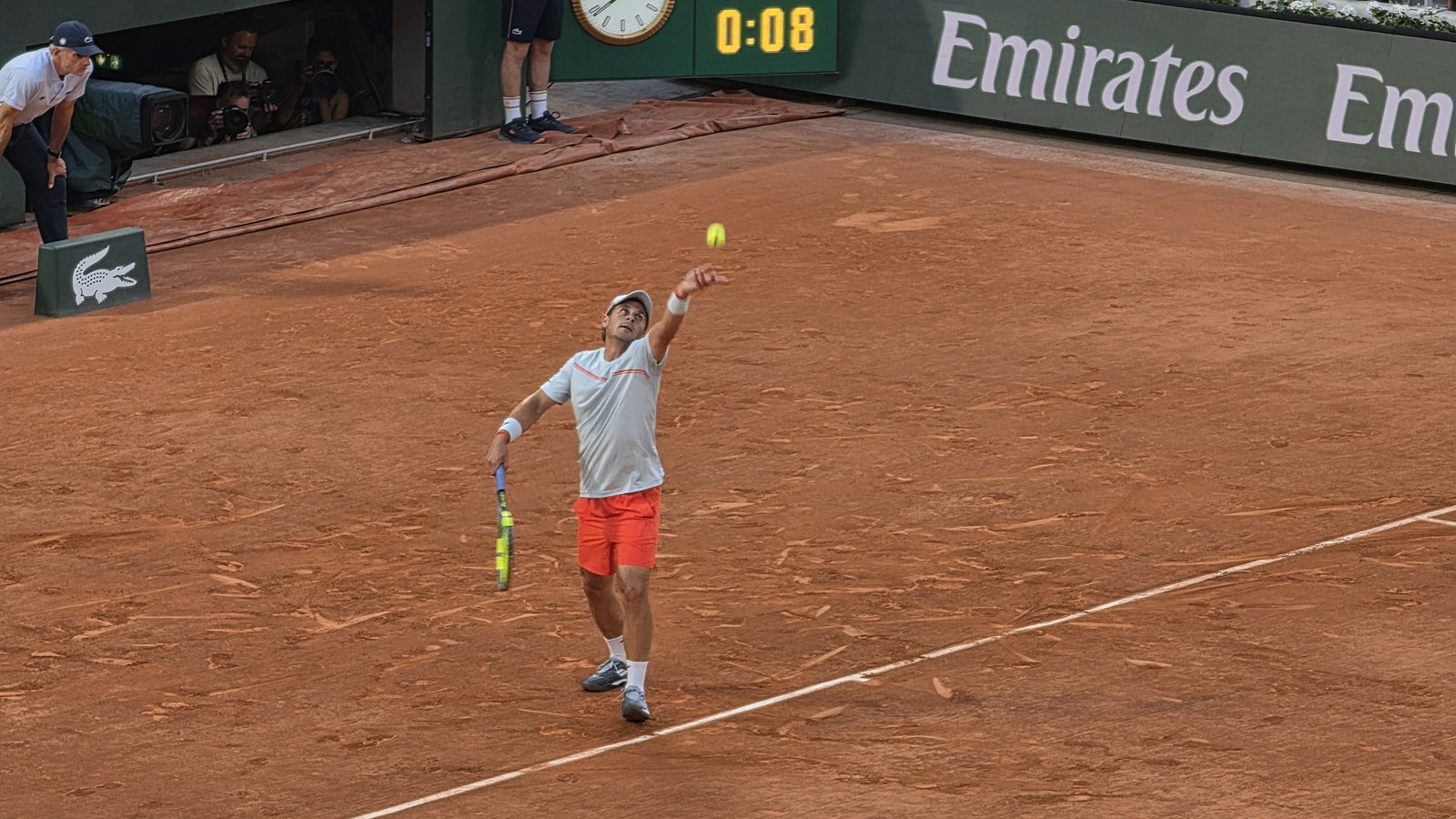
- Each prompt asks a single question: form, serve, rest, head-to-head and odds.
- The typical AI mistake in tennis is mixing surfaces and seasons: always ask for the data point separately.
- In tennis there is no draw, and a retirement can void the bet depending on each bookmaker's rules.
Save this article: the next time you look at a tennis match, come back, copy the prompt you need and pick up where you left off.
Your progress is saved in this browser.
Which prompts work for tennis betting?
Tennis is an individual sport with a lot of public data.
There are no teammates to cover for a bad day.
Even so, if you ask an AI “tell me who wins”, the answer comes out vague.
That is why this article splits the analysis into five prompts.
Each one asks a single question.
You put the answers together and draw your own conclusions.
All the prompts use parameters in [BRACKETS].
Replace each one with your own data before you paste.
If you leave a bracket unfilled, the AI fills it with whatever comes to mind.
Two tennis rules that change the bet.
There is no draw: the match winner market has only two outcomes.
If a player retires, the bet may or may not be voided, depending on each bookmaker's rules.
Read those rules before you bet.
This article does not explain the sport from scratch.
For that there is the guide to AI for tennis betting.
And if you are looking for a prompt for another market, there is the index of ChatGPT prompts for every betting market.
Before you paste: three rules so the AI answers better
- Turn on web search: without it, the AI does not have this week's matches.
- State the tournament, round, surface and format: a best-of-3-sets match is not the same as a best-of-5.
- Paste the odds yourself: you see them at your bookmaker, the AI does not.
Features change: check in the app what your plan includes.
No AI bets for you or knows the result.
All of them can make up data.
Prompt 1: recent form and surface
This is the starting prompt.
A player can perform very differently on clay, on hard court and on grass.
That is why recent form is always read together with the surface.
Analyze the match between [PLAYER A] and [PLAYER B] on [DATE], in [TOURNAMENT], round [ROUND], on [SURFACE].
For each one, give me the last [N] matches: date, opponent, tournament, surface, result and score.
Separate the [SEASON] record on [SURFACE] from the record on all other surfaces.
State whether either is coming back from an injury or a long break.
Indicate the number of matches in each record and the source.
If you cannot verify a data point, write “I don’t know”.
What it returns
A profile of each player with their last matches and two records.
One on the surface of the match and one on the others.
It is the basis for the other four prompts.
How to verify it
Open the source and check two matches at random.
Make sure the surface of each tournament is correct.
If the record on the surface comes from four or five matches, take it with a grain of salt.
Prompt 2: serve and return
Tennis is decided in two moments: when you serve and when you return.
A player who wins almost all of their service games goes far in every set.
One who breaks often settles matches faster.
For [PLAYER A] and [PLAYER B], on [SURFACE] during [SEASON], give me the serve data: first-serve percentage, points won on the first serve, points won on the second serve and service games won.
Add the return data: points won on the opponent's serve, break points converted and return games won.
Indicate how many matches each percentage is calculated from.
Do not mix surfaces or seasons.
Cite the source of each number and write “I don’t know” if you do not have it.
What it returns
A table with each player's serve and return.
It is useful for the match winner market and also for total games.
Two good servers tend to take sets to more games, but it is not a fixed rule.
How to verify it
The official sites of the tours publish these statistics.
Check two percentages and the number of matches.
If the numbers are from the player's whole career, they are no use for this match.
If you want to build your own spreadsheet with these metrics, follow the guide to how to bet on tennis with Tennis Metrics.
Prompt 3: match load and rest
In tennis there is no rotation and there are no substitutes.
The one who played three long sets yesterday is back on court today.
This prompt measures how much each player has been playing.
For [PLAYER A] and [PLAYER B], before the match on [DATE] at [TOURNAMENT]: how many matches has each played in the last [N] days?
Give me the duration and the number of sets of each match they played in this tournament.
Tell me how many hours of rest each has had since their last match and whether they are coming from playing another tournament the week before.
Add whether either has asked for medical attention or retired from a match in recent weeks.
Cite the source and write “I don’t know” if you cannot verify something.
What it returns
A summary of each player's load: matches, sets, duration and rest.
Also a warning about recent physical complaints.
That warning matters twice as much because of the retirement rule.
How to verify it
Check the tournament draw and the duration of each match on the official site.
Physical complaints are the least reliable data point: look for a dated press report.
Fatigue is a context data point, not a signal on its own.
The topic has its own article, with a table you can build: how to measure a tennis player's fatigue with AI.
Prompt 4: the head-to-head record, read with care
The head-to-head record between two players is the most quoted data point and the most misleading.
It usually has few matches.
Many were played on another surface or several years ago.
List all the matches between [PLAYER A] and [PLAYER B]: date, tournament, surface, round and score.
Separate the ones played on [SURFACE] from the rest.
Tell me how many were played in the last two years.
Flag whether any match ended in a retirement.
If there are fewer than [N] matches on [SURFACE], tell me the sample is small and do not draw conclusions.
Cite the source and write “I don’t know” if you cannot verify a match.
What it returns
A list of matches with date and surface.
What is useful is not the total, but how many are recent and on today's surface.
Often the honest answer is that it is not enough to conclude anything.
How to verify it
Count the matches at the source and compare them with the list.
The AI sometimes makes up a match or changes the winner.
If the record is two or three matches, leave it out of your analysis.
Prompt 5: the odds against the implied probability, and the checklist
This is the closing prompt.
First it converts the odds into percentages.
Then it reviews your analysis and looks for gaps.
The match winner odds for [PLAYER A] vs [PLAYER B] are [ODDS A] and [ODDS B].
The total games line is [LINE], with the over at odds [OVER ODDS] and the under at odds [UNDER ODDS].
Calculate the implied probability of each of the odds and the bookmaker's margin in each market, step by step.
Then act as a critical reviewer of my analysis: [PASTE YOUR DATA AND CONCLUSIONS].
Tell me: 1) which data point is not verified, 2) whether I mixed surfaces or seasons, 3) whether any sample is small and 4) what happens to my bet if there is a retirement.
Mark which part of your answer is calculation and which part is opinion.
Do not give me a betting verdict.
What it returns
Four implied probabilities, the margin of each market and a list of risks.
With that you see what the market expects and where your analysis has gaps.
If you do not know how to read those percentages, review implied probability.
| Market (example) | Odds | Implied prob. | Without margin |
|---|---|---|---|
| Winner: player A | 1.50 | 66.7% | 63.4% |
| Winner: player B | 2.60 | 38.5% | 36.6% |
| Over 22.5 games | 1.85 | 54.1% | 51.3% |
| Under 22.5 games | 1.95 | 51.3% | 48.7% |
The numbers in the table are an example to show the calculation.
The implied probabilities for the winner add up to 105.1%, and those for total games to 105.3%.
Whatever goes over 100% is the bookmaker's margin.
The “without margin” column spreads that excess proportionally, and it is an approximation.
How to verify it
Redo the calculations with the odds converter and the expected value calculator.
Check the format of the match: the games line changes a lot between 3 and 5 sets.
And read the retirement rule for each market, because it is not always the same.
How to use the 5 prompts in order: step by step
What are the most common mistakes with these prompts?
- Accepting an overall record when the match is on a specific surface.
- Giving weight to a head-to-head record of two or three matches.
- Forgetting the format: the games line of a 5-set match cannot be compared with one from a 3-set match.
- Not reading the retirement rule before betting.
- Trusting a serve statistic with no source and no number of matches.
The prompts help you think in an orderly way.
They do not replace a data source or a log of results.
A well-written answer is not a true answer.
What Gambeta does with tennis, with no promises
Gambeta publishes AI tennis predictions with its own model.
Each one is recorded with its odds before the match.
You can review it afterward in the public track record, win or lose.
If you want to see how it works across all sports, head to the betting AI guide, with free predictions from the Gambeta AI every day.
A prediction is not a promise.
No tennis bet is safe.
For adults 18 and over only.
Bet only money you can afford to lose, set a limit before you start and stop if you stop enjoying it.
More at betting responsibly.
What to read next
If you liked the format, there is another article of prompts by sport: the 5 best prompts to analyze NBA games.
For football, continue with the 5 prompts for corner betting and the 5 prompts for yellow card betting.
From this same batch are the prompts for anytime goalscorer bets and the prompts for live betting.
Live tennis is especially fast, so read that article before trying it.
And if you want a prompt tailored to you, build it with the prompt builder.
Frequently asked questions
Which prompt should I use for tennis betting?
Start with the one for recent form and surface.
Then add the one for serve and return and the one for match load.
Finish with the odds one, which includes the checklist.
Does ChatGPT know each player's serve statistics?
Only if it looks them up online, and even then it can be wrong.
It often mixes surfaces or gives percentages from another season.
Ask for the source and check the number before you use it.
Is the head-to-head record between two players useful?
It is of little use when there are few matches.
Three or four meetings, on another surface or from years ago, predict nothing.
Use it as context and not as the main argument.
What happens to my bet if a player retires?
It depends on your bookmaker's rules.
Some void the bet if the match is not completed, and others treat it as valid from a certain point.
Read those rules before you bet, market by market.
Why is there no draw in tennis?
Because the match is played until one player wins the required sets.
The match winner market has only two outcomes.
That is why its odds are read differently from the 1X2 in football.
Does a good prompt guarantee I will pick the winner?
No.
In tennis the favorite loses too, and a bad day or a physical complaint changes everything.
A prompt organizes the data, but betting always carries the risk of losing money.