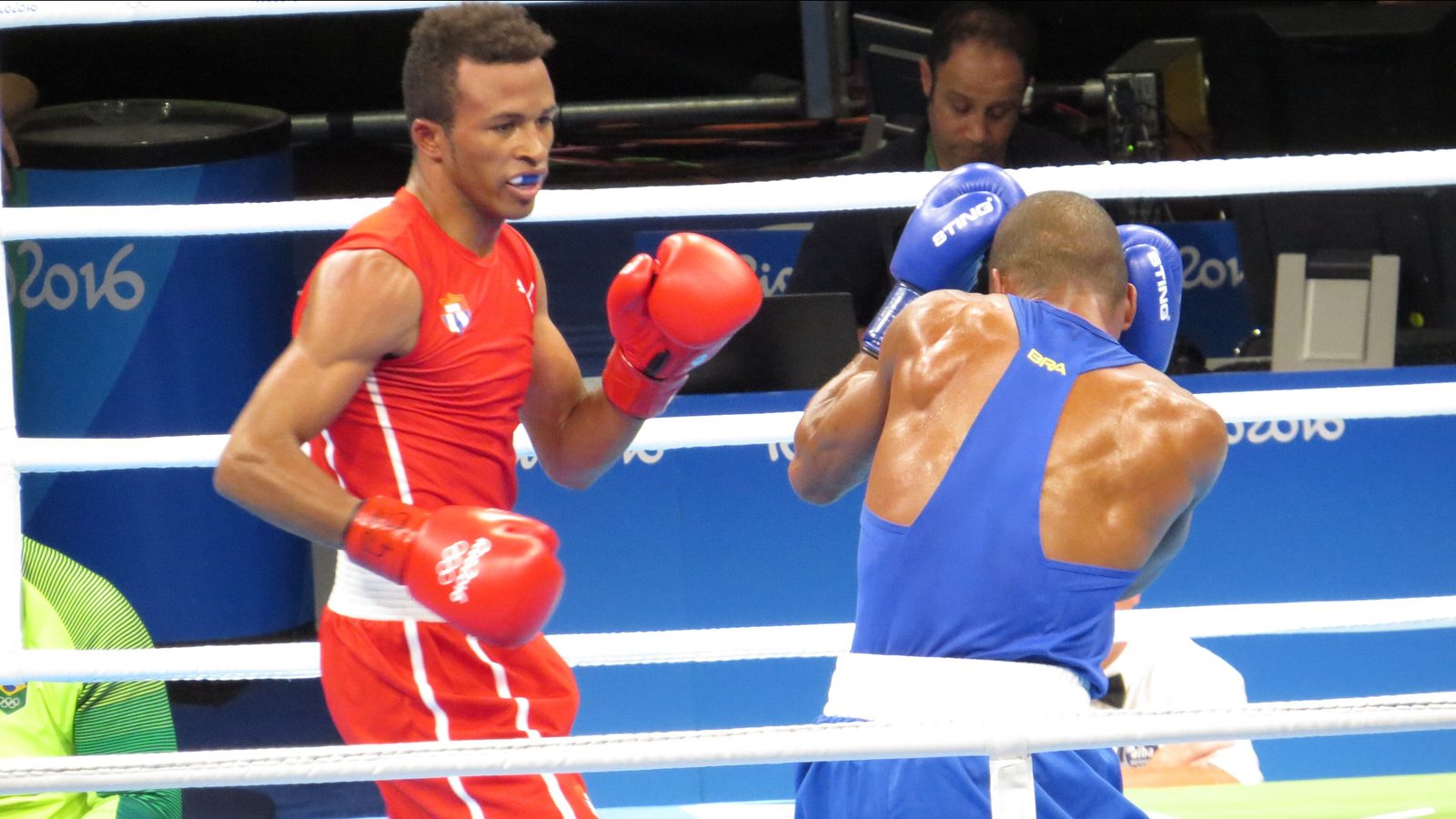

- Each fighter has very few fights: the model has to be simple and humble.
- The path is always the same: probability → fair odds → compare with the odds → value.
- Gambeta does not currently publish regular picks for boxing or UFC: this is a guide so you can build the model yourself.
Save this guide: it is a long one and works best followed one step at a time, with a spreadsheet open beside it.
Your progress is saved in this browser.
Can you model a fight with machine learning?
You can model it, within very clear limits.
Boxing and mixed martial arts (MMA) are contact sports.
A single punch can end a fight that was even.
That puts a lot of variance into every result.
There is also little data.
A footballer plays 50 matches a year.
A boxer fights two or three times a year.
A UFC fighter usually fights two or three times a year.
Machine learning needs many examples to learn reliable patterns.
Here the examples are few, the opponents change and the styles clash in different ways.
That is why a good fight model is simple, prudent and always uncertain.
This article is a guide to learning how to model.
Gambeta does not currently publish regular boxing or UFC picks.
What you do have here are tools and a method so you can reason for yourself.
Which variables to look at when modeling a fight
A model is a list of variables and a weight for each one.
These are the most used in boxing and in MMA.
The table says what each one contributes and what its trap is.
| Variable | What it contributes | Trap |
|---|---|---|
| Age | Physical decline and reflexes | Every body ages differently |
| Reach | Distance and control of the ring | Loses value if the style is inside fighting |
| Streak | Recent form | Depends on whom they beat |
| Style | How it clashes with the opponent | Hard to put into a number |
| KO record | Punching power and chin | Few fights, a lot of noise |
| Weight and cut | Condition at the weigh-in | Almost never known from the outside |

Age, reach and streak: what can be measured
Age, reach and height are published.
They are easy to load into a spreadsheet.
That is why every homemade model starts there.
The problem is that every bettor sees them too.
If a variable is public, the odds already account for it.
The value shows up in what the market measures worst.
In fights, that is usually the real level of the previous opponents.
Style and level of opponents: what costs the most
A streak of five wins says nothing without context.
Five wins against weak opponents are worth less than two losses against elite ones.
A good model adjusts the streak for the quality of each opponent.
Style matters too.
A pressure fighter against a counterpuncher behaves differently than against a long-range boxer.
It is hard to turn into a number, and that is where information is lost.
Why there is little data and a lot of variance
In a team sport, a mistake gets diluted over 90 minutes.
In a fight, a two-second mistake can decide everything.
That makes the better fighter win less often than it seems.
Two consequences for you.
First: a good model will still lose many bets that were worth making.
Second: a short streak, good or bad, says almost nothing about the model.
If you want to dig deeper into how many bets you need to draw conclusions, read how many bets you need to know whether you are winning.
It is the foundation of everything that follows.
Which markets can be modeled: winner, method and rounds
In a fight there are three main markets.
Each has a different level of difficulty.
| Market | Outcomes | Difficulty |
|---|---|---|
| Winner | Two (sometimes a draw) | Medium: the simplest to model |
| Method | KO, decision, others | High: the sample gets split |
| Rounds | Over or under a line | High: depends on pace and the judges |
Always start with the winner.
It has fewer categories and more example fights.
Only when the winner works for you should you try method and rounds.
How to go from a model to a probability
The simplest way is a points system.
Each fighter has a rating that goes up when they win and down when they lose.
Beating a strong opponent adds more than beating a weak one.
The rating difference is turned into a probability with a well-known formula.
It is the same one used in chess.
It is called the Elo system.
Example: with a 100-point difference, the Elo system gives the better fighter 64.0%.
At fair odds, that is 1.56.
The numbers are an example to understand the method, not those of any real fighter.
Elo is a starting point.
Afterwards you can add adjustments: age, reach, style.
Each adjustment should move the probability a little, not a lot.
The humility trick: pull the probability toward 50%
With little data, your extreme probabilities are almost always exaggerated.
A simple technique is to blend your estimate with the neutral 50%.
It is called shrinkage and it reduces overconfidence.
Example: your model says 70% and you give half the weight to the neutral 50%.
The final probability ends up at 60%.
It is more prudent and tends to perform better with small samples.
From probability to fair odds and to value
Fair odds are 1 divided by the probability.
If you estimate 62%, the fair odds are 1.61.
If the bookmaker pays more than that, there is apparent value.
Expected value (EV) measures how much you would win on average per unit staked.
It is calculated by multiplying probability by odds and subtracting 1.
| Data (example) | Calculation | Result |
|---|---|---|
| Prob. 62%, odds 1.80 | 0.62 × 1.80 − 1 | EV +11.6% |
| Prob. 58%, odds 1.80 | 0.58 × 1.80 − 1 | EV +4.4% |
| Prob. 58%, odds 1.70 | 0.58 × 1.70 − 1 | EV −1.4% |
Look at what happens.
Four points of difference in the probability change an EV from 11.6% to 4.4%.
A small model error wipes out almost all the value.
You can do these calculations with the expected value calculator.
If you do not remember what fair odds are, review implied probability.

Watch the margin: the bookmaker charges up front
The bookmaker’s odds do not add up to 100%.
They add up to a bit more.
That extra is the margin, and it is the first thing you subtract from your value.
Example: odds of 1.80 and 2.05 in a fight.
The implied probabilities add up to 104.34%, a margin of 4.34%.
Without the margin, the market would say 53.2% and 46.8%.
If your model says 52% for the favorite and the market says 53.2% without margin, there is no edge.
The odds of 1.80 only look tempting.
More detail in what the bookmaker’s margin is.
Method of victory and rounds: more categories, less data
The method is split into categories.
Win by KO or TKO, by decision, by submission (in MMA) or by disqualification.
Each category has very few examples.
It is modeled as a chain.
First the probability of winning.
Then, within that win, how the method is distributed.
Example: the favorite wins 62%.
Of those wins, 40% are by KO or TKO.
Probability of winning by KO: 24.8%, fair odds 4.03.
If the bookmaker pays 4.00, the EV is −0.8%.
Almost no value, even though the odds look high.
The longer the odds, the easier it is to believe there is a bargain.
Rounds are modeled the same way.
First the probability that it ends before the line.
It depends on the pace, the chin and how many rounds the fight has.
How to evaluate a model with very few fights
This is the hardest point.
With five or ten fights you cannot know whether your model is good.
You can have good luck and believe you nailed the method.
The confidence interval helps you see that risk.
It is the range in which your true hit rate could lie, given what you measured.
| Sample (example) | Hits | Plausible range |
|---|---|---|
| 8 fights | 6 of 8 (75%) | 41% to 93% |
| 80 fights | 60 of 80 (75%) | 65% to 83% |
The same 75% hit rate in both rows.
With 8 fights, the real figure could be as low as 41%, a mediocre result.
With 80 fights, the range shrinks a lot.
A better way to evaluate is the Brier score.
It measures how far your probability was from the result, not just whether you were right.
The closer to 0, the better.
Example: five fights with probabilities of 70%, 60%, 65%, 80% and 55% give a Brier score of 0.203.
Saying 50% every time gives 0.250.
With so few cases, that difference is still noise.
Two practical rules.
First: save every probability before the fight, never after.
Second: do not change the model because of a single result.
Biases that no model sees easily
Some things matter a lot and are not in any database.
They are the blind spots of any fight model.
- Hidden injuries: a fighter can arrive with a damaged hand or knee and nobody reports it.
- Weight cut: dropping a lot of weight in a few days can leave him without strength on fight day.
- Home side and referee: in close decisions, the venue and the judges can tip the result.
- Last-minute changes: replacement opponents, fights that fall through, weight classes that change.
- Old data: the fighter from three years ago is not always the one of today.
Given these blind spots, the model has to be prudent.
If the fight has too many unknowns, the soundest decision may be not to bet.

How much to bet if you find value: a prudent stake
Finding value does not tell you how much to bet.
The Kelly criterion calculates a fraction of the bankroll based on the edge you believe you have.
The problem is that it depends on your probability being correct.
Example: probability 62% and odds 1.80.
Full Kelly suggests 14.5% of the bankroll.
A quarter Kelly would be 3.6%, much more reasonable with an uncertain model.
With models built on little data, always use a fraction of Kelly.
Try it in the Kelly calculator and compare.
A fixed cap per fight also helps.
Step by step: your first fight model in a spreadsheet
If you would rather have an AI help you with the spreadsheet code, see how to create and train your own AI for betting.
The same method works for you.
What Gambeta does and what it does not
To be clear.
Gambeta does not currently publish regular boxing or UFC picks.
We are not going to offer you something we do not have.
What you can use:
the free value, Kelly and margin calculators, and the Betting Journal to see how our own model reasons about other sports.
Everything we publish stays in the public record.
If the value method interests you, the foundation is the same in any sport.
Read value betting and come back to this guide with the spreadsheet open.
Wrap-up: modeling is about learning, not about winning for sure
Modeling a fight forces you to think better.
It shows you what you know, what you assume and what you ignore.
That is the real value of the exercise.
A model guarantees nothing.
In contact sports, variance is enormous and the sample is small.
If you bet, do it with a fixed cap and without chasing losses.
Content for adults 18 and over only.
If you feel you are losing control, read betting responsibly.
The natural next step is the complete guide to AI for betting.
Frequently asked questions
Can you predict a boxing or UFC fight with AI?
You can estimate a probability, not predict a result.
A fight can change with a single punch.
A good model gives you a range of probabilities and helps you decide whether the odds pay for it.
Which variables matter most in a fight?
There is no single one.
The most used are age, reach, streak, level of previous opponents, style and how their fights ended.
None is enough on its own: they are combined and tested.
How many fights do you need to trust a model?
Many more than any single fighter has.
With 8 or 10 evaluated fights, the result may be down to chance.
The sound approach is to measure with hundreds of fights and distrust any short streak.
Which market should you model first?
The winner, because it has two outcomes and more examples.
Method and rounds are harder: they split into more categories and each one has less data.
Does Gambeta publish boxing or UFC picks?
Not today, not on a regular basis.
Gambeta’s picks focus on other sports and markets.
What we do offer are free tools to calculate value, margin and stake, and the Betting Journal to see how our own model reasons.
Does a model guarantee that I will win?
No.
A model only organizes uncertainty.
It can be wrong, and the bookmaker’s margin works against you.
Bet only what you can afford to lose and only if you are 18 or over.