
- In baseball, the starting pitcher and the weather move almost every line.
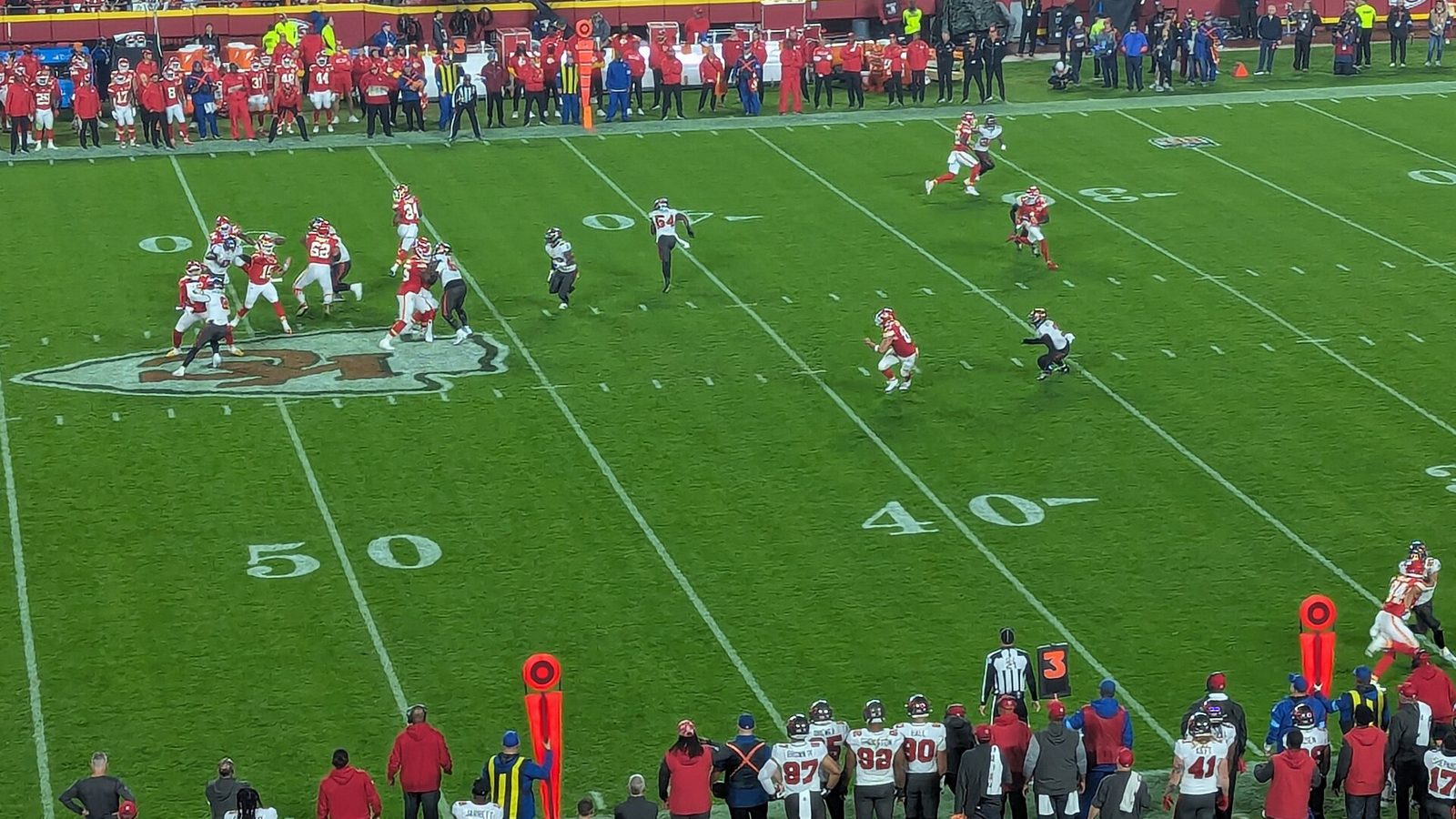
- In American football, inactives and game script change passing and yardage.
- The AI helps you organize: you supply the data, it does the math.
Save this guide so you have it handy on NFL Sundays and baseball days.
Your progress is saved in this browser.
What are NFL and MLB props?
A prop is a bet on one player's statistic.
The sportsbook sets a line and you choose over or under.
In this guide we look at two sports with different logic.
For basketball, see the guide to NBA props with AI.
| Sport | Typical props | What moves them most |
|---|---|---|
| NFL | Passing yards, rushing yards, receptions | Inactives, game script, weather |
| MLB | Starter's strikeouts, hits, total bases | Starter, opponent, ballpark and weather |
The figures in the examples are examples.
They do not belong to any real player.


Baseball: why the starting pitcher changes everything
A starter pitches between five and seven innings.
The starter's level decides almost everything that happens in those innings.
That is why baseball props are built around the starter.
If the starter changes, the line is no longer valid.
Gambeta treats the starting pitcher as a requirement.
Its baseball model uses a pitcher effectiveness indicator that blends the starter's season performance with a dose of caution for small innings samples.
If the starter is not confirmed, the pick is not published.
That rule is also good practice for you.
- Confirmed starter: name, handedness and expected innings.
- Opponent: how often the opposing lineup strikes out.
- Ballpark: some parks favor power hitting.
- Weather: wind, temperature and rain.
- Bullpen: if the starter leaves early, the relievers come in.
Starter strikeouts: an example with the math
Strikeouts come down to a simple calculation.
Strikeouts per inning times innings pitched.
A starter with 9 strikeouts per 9 innings strikes out 1 per inning.
With 5.5 expected innings, the projection is 5.5 strikeouts.
With a line of 5.5, the over needs 6 strikeouts or more.
An approximation with the Poisson distribution gives these results.
It is a simplification, but it shows how sensitive the result is.
| Expected strikeouts (example) | Probability of 6 or more | Against odds of 1.90 (52.6%) |
|---|---|---|
| 4.5 | 29.7% | No value |
| 5.5 | 47.1% | No value |
| 6.5 | 63.1% | There is a margin |
Notice how sensitive the result is to expected innings.
Half a strikeout more or less changes the probability by more than fifteen points.
That is why it matters whether the starter leaves early.
The figures in the table were calculated with an approximation and are an example.

Weather in baseball and in American football
Weather weighs differently in each sport.
In the NFL, rain and strong wind cut down long passes.
In MLB, wind blowing out helps fly balls and wind blowing in holds them back.
Check the forecast as close to game time as possible.
| Condition | NFL | MLB |
|---|---|---|
| Strong wind | Fewer deep passes | Changes total bases |
| Rain | More running plays | Risk of delay or suspension |
| Cold | Less accuracy | Fewer long hits |
A prop on a suspended game is usually voided.
Read your sportsbook's rules on incomplete games.
NFL: inactives, role and game script
In American football, the key piece of data is who is active.
The league publishes the inactive list a few hours before the game.
Before that, everything is provisional.
Waiting for that list avoids many mistakes.
- Inactives: a receiver or a running back out changes the distribution.
- Game script: a team that is winning runs more and passes less.
- Opponent: strong pass defenses lower passing yards.
- Role: is the player a starter or do they rotate with someone else?
- Weather: see the table above.
Here is a passing yards example, with made-up numbers.
A line of 249.5 yards, over and under at 1.91.
The implied probability is 52.4% on each side, and the margin is 4.7%.
A quarterback who throws 34 times at 7.0 yards per attempt projects to 238 yards.
If there is rain and the team throws 30 times, the projection drops to 210.
That puts it 39.5 yards below the line, which points to the under, just from weather and volume.
But the attempts figure is also an estimate.
That is why it is better to test scenarios instead of a single number.
| Scenario (example) | Attempts | Yards per attempt | Projection |
|---|---|---|---|
| Normal game | 34 | 7.0 | 238 |
| Rain | 30 | 7.0 | 210 |
The prompt to evaluate a baseball prop
Act as a baseball analyst. Evaluate: [PLAYER] [STAT] [OVER/UNDER] [LINE] at odds [ODDS] on [DATE].
Data I am giving you: confirmed starter [STARTER] with strikeouts and innings from their last 5 games [DATA], opposing lineup [OPPONENT], ballpark [BALLPARK], weather [WEATHER].
Do this: 1) project innings or at-bats, 2) calculate the expected stat, 3) estimate the probability of clearing the line, 4) compare it with the implied probability, 5) list the risks.
Show the math. If you do not have a piece of data, write "I don't know". Do not use the word guaranteed.
The prompt to evaluate an NFL prop
Act as an American football analyst. Evaluate: [PLAYER] [STAT] [OVER/UNDER] [LINE] at odds [ODDS] on [DATE].
Data I am giving you: the player's role and volume over the last 5 games [DATA], official inactives for both teams [INACTIVES], weather [WEATHER], game total and expected spread [GAME LINE].
Do this: 1) project attempts or touches, 2) multiply by the per-attempt performance, 3) estimate the probability of clearing the line, 4) compare it with the odds, 5) list the risks.
Show every calculation. If a piece of data is missing, say "I don't know".
To build these texts without writing from scratch, try the prompt builder.
And to choose an AI that searches for sources, see the AI comparison.
What Gambeta does with baseball and American football
Gambeta publishes baseball picks with starters and series.
If there are no confirmed starters, the model does not produce the pick.
We explain it in MLB picks with AI.
For American football, see today's NFL picks.
Every pick is recorded before the game.
You can see the result in the public record.
We do not promise performance: past results do not guarantee future ones.
The limits of an AI with these props
- It does not know today's inactives without a source.
- It does not know the starter if they changed an hour ago.
- It cannot see the wind at the ballpark at game time.
- It can get the math wrong if you do not ask for step by step.
- It does not manage your bankroll.
A prop carries a lot of variance.
A single injury during the game ruins any analysis.
That is why it is wise to cap the amount and keep a log with the tracking spreadsheet.
What to read next
If you want to understand rest and travel, continue with fatigue and schedule.
If you are into basketball, read NBA props with AI and the back-to-back.
And to see how it all connects, go back to the AI for betting pillar guide and the Betting Journal.
For adults 18 and over only.
Bet only money you can afford to lose.
See our responsible gambling guide.
Frequently asked questions
What is an NFL prop bet?
It is a bet on a player, not on the game result.
For example, passing yards, rushing yards, receptions or touchdowns.
The sportsbook sets a line and you pick over or under.
See the basics in what props are.
What is an MLB prop bet?
It is a bet on a player's performance in a single game.
The most common are the starter's strikeouts, hits, total bases and RBIs.
The starting pitcher of the day is the key piece.
Without a confirmed starter, it is better not to analyze.
Why does the starting pitcher matter so much in baseball?
Because the starter pitches most of the game and sets the level of the opponent.
A last-minute change of starter changes every line.
That is why Gambeta does not publish an MLB pick without confirmed starters.
Always confirm who is pitching before you evaluate.
How does the weather affect props?
Wind and rain change passing and hitting.
In rain or strong wind, teams tend to pass less.
In baseball, wind blowing with or against the hitter changes total bases.
Check the forecast close to game time.
What is an inactive player in the NFL?
It is a player who is not eligible to play in that game.
The league publishes the inactive list a few hours before kickoff.
Until then there are questionable players and everything is provisional.
Waiting for the official list avoids many mistakes.
Can an AI get these props right?
Not reliably.
It can estimate probabilities with the data you give it.
The result of a game carries a lot of variance.
The AI organizes your analysis, it does not replace it.