What Polymarket is
Polymarket is a prediction market: instead of a sportsbook setting odds, traders buy and sell shares in an outcome. It runs on the Polygon blockchain and settles in the USDC stablecoin.
It became known for politics, but it lists sports markets too, from a Champions League winner to a single NBA game. The mechanics are identical whatever the event.
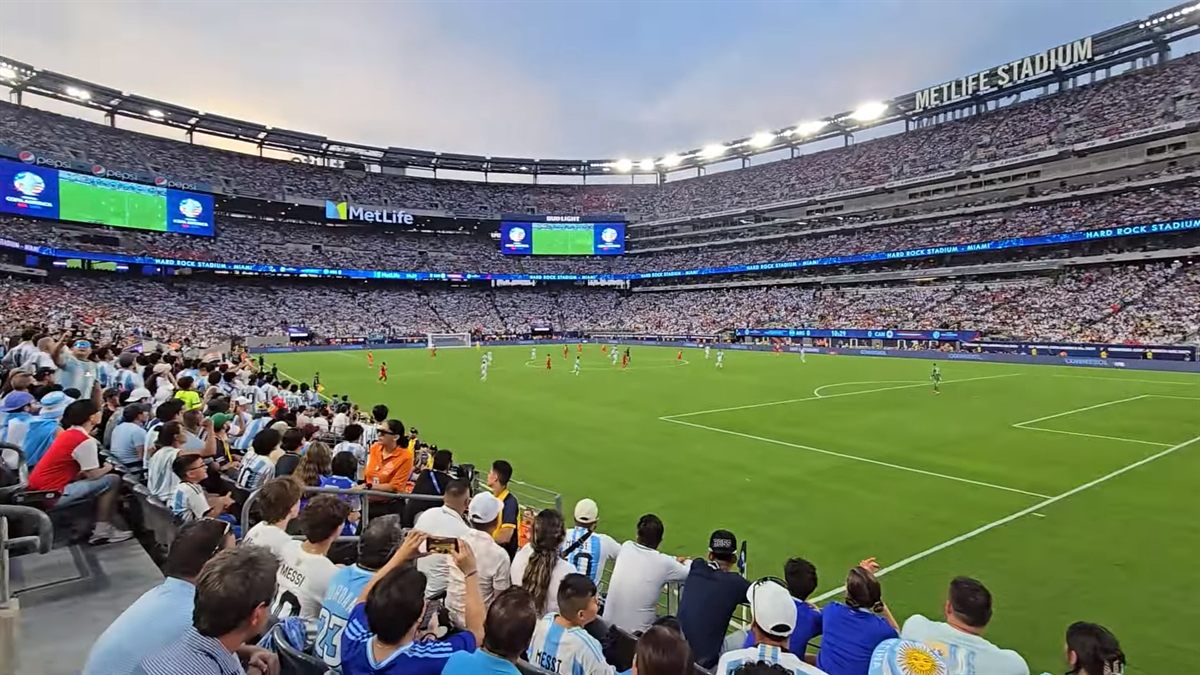
MetLife Stadium, Argentina vs Canada, Copa América 2024 semifinal. Big tournaments are where prediction markets attract the most volume. Photo: Sebas — CC BY 3.0 (Wikimedia Commons).
How a price becomes a probability
Every outcome has a YES share and a NO share, each priced between one cent and ninety-nine cents. If the YES share trades at 35 cents, the market is saying the outcome has roughly a 35-in-100 chance.
If it happens, each YES share pays one dollar; if not, it pays nothing. The price you pay is the implied probability, with no vig baked in by a house.
Prediction market vs sportsbook
| Aspect | Polymarket | Sportsbook |
|---|---|---|
| Who sets the price | Other traders | The house |
| Format | Share price in cents | American, decimal or fractional odds |
| Built-in margin | None, but small trading fees apply | Yes, the vig |
| You can sell before the end | Yes | Only with cash-out |
| Currency | USDC on Polygon | US dollars |
To compare the two, convert the sportsbook's odds into a probability first. American odds of -150 mean roughly a 60-in-100 chance, which is a 60-cent share; our odds and probability guide walks through the conversion.
Where it is available, and where it is not
Polymarket runs an international exchange and, since late 2025, a separately regulated US version with identity checks under CFTC oversight. Availability changes fast, so treat any list as a snapshot.
Outside the US, access in 2026 is blocked or restricted in several countries, including Argentina after a court ruling, Brazil after a resolution banning event derivatives, and Spain under a regulator's temporary block. The rest of this guide is still useful for reading probabilities wherever you are.

Two players contest the ball in a university league match, 2024. A market price and a model probability describe the same match in two languages. Photo: Jackshots256 — CC BY-SA 4.0 (Wikimedia Commons).
Using market prices with an AI model
A market price is the crowd's estimate; a model's probability is a single, explainable estimate. When the two disagree, one of them is mispricing the match, and that gap is where value lives.
gambeta.ai publishes free predictions for soccer, tennis and baseball with the model's probability and a suggested stake. Reading a Polymarket price next to it tells you at a glance whether the crowd is more or less confident than the model.
Compare with today's AI probabilities →
Frequently asked questions
Is Polymarket a sportsbook?
No. It is a prediction market where traders set the price of each outcome; there is no house taking the other side of your bet.
What does a 60-cent share mean?
That the market gives the outcome roughly a 60-in-100 chance, and that the share pays one dollar if it happens.
Is Polymarket legal in the US?
As of 2026 there is a separately regulated US version with identity verification under CFTC oversight. Rules change, so check the current status before trading.
Can I use Polymarket prices to find value?
Yes, by comparing the share price with an independent probability. If a model or a sportsbook disagrees with the market, someone is mispricing the event.