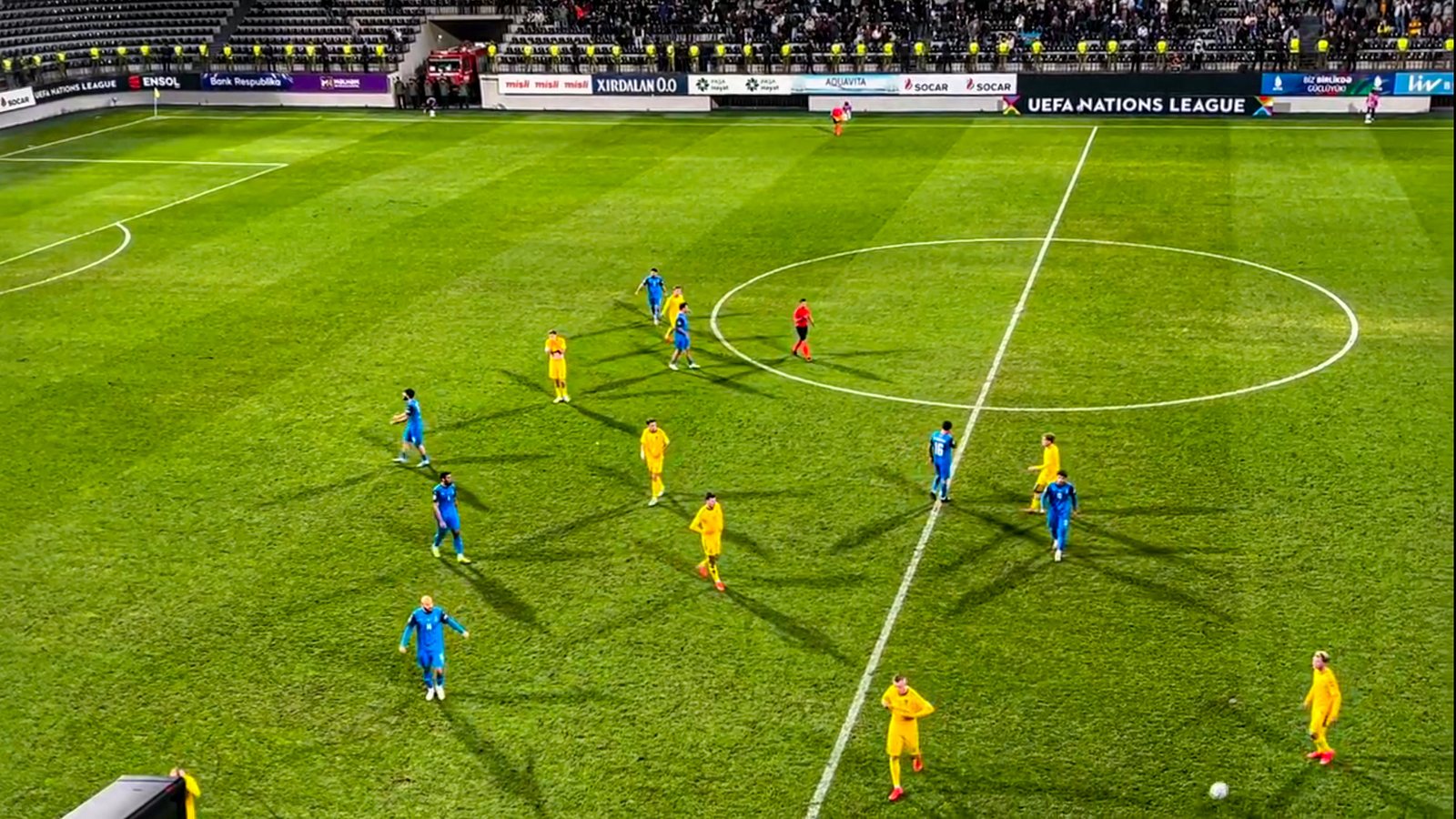
- In a tournament context weighs as much as quality: format, rest, travel and what each team needs.
- The AI does not know the current state of the table: you paste in the rules and the results.
- A prompt organizes your tournament analysis, it does not pick the bet and it does not predict a result.
Save this article: at the start of the next group stage or the next cup, come back, copy the prompt you need and pick up where you left off.
Your progress is saved in this browser.
Which prompts work for betting on a national team tournament?
A national team tournament is not analyzed like a league.
There are few matches, few rest days and a lot at stake on every matchday.
If you ask an AI “analyze this group for me”, the answer comes out generic.
That is why this article splits the analysis into five prompts.
Each one asks a single question.
You put the answers together and draw your own conclusions.
All the prompts use parameters in [BRACKETS].
Replace each one with your own data before you paste.
If you leave a bracket unfilled, the AI fills it with whatever comes to mind.
They work for national team tournaments and also for cups with groups or knockout ties.
We do not explain the outright winner market here: for that there is the article on prompts for betting on champion, promotion and top scorer.
Golden rule: the AI does not see your tournament’s table or yesterday’s results.
In every prompt we ask for a source and for it to write “I don’t know” when it cannot verify.
Even so, check each data point yourself before you bet.
Before you paste: three rules so the AI answers better
- Paste the rules and the table: tiebreaker criteria and best third-place spots change from one tournament to another.
- Paste the odds and the market: you see them at your bookmaker, the AI does not.
- State today’s date: without it, the AI may mix the current edition with a previous one.
Prompt 1: tournament format and what each team needs
This is the starter prompt.
It sorts out how qualification works and what each team needs today.
The key is for the AI to work with the rules you paste, not the ones it remembers.
These are the rules of the [TOURNAMENT] and the table of [GROUP] as of [DATE]: [PASTE THE RULES AND THE TABLE].
Explain to me in short steps how a team qualifies and what the tiebreaker criteria are, in order.
For each team in the group tell me which results qualify it, which eliminate it and which depend on another match.
Use only the data I pasted.
If something does not appear in the text, write “I don’t know”.
What it returns
A map of scenarios for each team.
What is enough for it, what is more than it needs and what does not depend on it.
It is the base for the other four prompts.
How to verify it
Compare the tiebreaker criteria with the tournament’s official page.
Recalculate one scenario by hand with the real table.
If there is an error in one criterion, distrust the whole map.
If the rules mention how markets are settled, do not mix that with the competition’s rules.
For that there is the article on prompts for reading the rules of your bet.
Prompt 2: the last matchday of the group and the incentives
The last matchday is the strangest of the tournament.
Two matches are played at the same time and each team watches the other scoreboard.
A team that is already through may rotate; one that needs to win may risk everything.
Analyze the match [TEAM A] vs [TEAM B], last matchday of [GROUP], played on [DATE] at the same time as the match [TEAM C] vs [TEAM D].
With the table I gave you, tell me what each one needs to qualify and what happens if the other match ends in a draw.
State whether any team is already through or eliminated.
The total goals line is [LINE], with the over at odds [OVER ODDS] and the under at odds [UNDER ODDS].
Explain how the pace may change depending on each team’s incentive.
Separate data from opinion and do not tell me whether it is worth betting.
What it returns
A table of needs and a reading of the incentives.
It also warns you when a draw suits both teams.
It is a hypothesis to think with, not a prediction.
How to verify it
Build the table yourself with every possible result.
Check whether the team that is “already through” really cannot lose first place.
Read the pre-match press conference or the coach’s comments: that is where rotations get confirmed.
Watch out for a false shortcut: “they have nothing to play for” does not mean “they will not try”.
A team that is through may still want to win to avoid a difficult tie.
Ask the AI for that scenario, but do not take it for granted.
Prompt 3: rest, travel and schedule
In a tournament, the days between matches weigh a lot.
Sometimes one team plays with three days of rest and its opponent with four.
Travel between venues and changes of climate or altitude also count.
For [TEAM A] and [TEAM B] in the [TOURNAMENT], build a table with: date of the last match, days of rest until [DATE], city of each match and approximate distance between venues.
Add whether there are changes of time zone, climate or altitude between venues.
State whether either team had to play extra time in its last match.
Only use data that you can cite with a source.
If you do not know a data point, write “I don’t know”.
What it returns
A comparison table of rest and travel.
It shows who arrives fresher and who carries more kilometres.
It helps you think about pace, not to decide on its own.
How to verify it
Count the rest days on the official calendar.
Look at the cities of each venue in the tournament’s fixture list.
A climate or altitude data point is confirmed in a forecast, not in the AI.
The general topic has its own article: fatigue and schedule in betting.
If your doubt is about absent players, see the prompts for weighing absences and doubts.
| Situation | What may change | What you ask the AI | Data point to confirm |
|---|---|---|---|
| Already through before the last matchday | Rotations and rest for starters | Scenario with and without changes | Pre-match press conference |
| Needs to win to go through | More risk and space at the back | What happens if the other match is a draw | Real table |
| A draw suits both teams | Lower pace | Results that qualify both | Tiebreaker rules |
| Fewer rest days than the opponent | Lower intensity at the end | Table of rest and travel | Official calendar |
| Long trip between venues | Fatigue and adaptation | Distance, time zone and climate | Tournament fixture list |
The table is a guide of questions, not a rule.
Each tournament and each squad is different.
A situation in the table may change nothing on the pitch.
Prompt 4: knockout ties and extra time
In a knockout tie, the match does not end when the referee blows the whistle.
There may be extra time and penalties.
That is why you have to separate the result after 90 minutes from the “to qualify” market.
Analyze the tie [TEAM A] vs [TEAM B] of [ROUND] of the [TOURNAMENT] on [DATE].
The odds for the home team to win after 90 minutes are [HOME ODDS], the draw is [DRAW ODDS] and the away team is [AWAY ODDS]. The “to qualify” odds for the home team are [QUALIFY ODDS].
Explain the difference between the two markets and calculate the implied probability of each of the odds, step by step.
Tell me how the pace may change if the match goes to extra time.
Do not assume data that I did not give you.
What it returns
A comparison between the 90-minute market and the to-qualify one.
The implied probabilities with the calculation in plain view.
A list of what changes if the match goes long.
How to verify it
Redo the calculations with the odds converter.
Read at your bookmaker how “to qualify” is settled: some include penalties and others do not always.
If your calculation and the AI’s do not match, yours is the one that counts.
| Market (example) | Odds | Calculation 1 ÷ odds | Implied prob. |
|---|---|---|---|
| Home after 90 min | 1.80 | 1 ÷ 1.80 | 55.6% |
| Draw after 90 min | 3.60 | 1 ÷ 3.60 | 27.8% |
| Away after 90 min | 4.50 | 1 ÷ 4.50 | 22.2% |
| Sum of the three | - | - | 105.6% |
The numbers in the table are an example to show the calculation.
The sum comes to 105.6%: the extra 5.6% is the bookmaker’s margin.
We explain it in what the bookmaker’s margin is and in implied probability.
Prompt 5: the checklist before betting on a tournament
This is the closing prompt.
It does not analyze the match: it reviews your analysis.
You ask it to look for gaps before you put money down.
This is my analysis of the match [TEAM A] vs [TEAM B] of the [TOURNAMENT], [STAGE], on [DATE]: [PASTE YOUR DATA AND CONCLUSIONS].
Act as a critical reviewer.
Tell me: 1) which data point is not verified, 2) whether I used outdated rules or an outdated table, 3) whether I confused the 90-minute market with the to-qualify one, 4) what information is missing (absences, rest, weather) and 5) what bias I may have.
Do not give me a betting verdict.
Just mark the risks.
What it returns
A list of gaps and risks.
It is the most useful prompt for stopping an impulsive bet.
If the list is long, maybe the best thing is not to bet.
How to verify it
Tick off each risk you resolved.
The ones you cannot resolve stay as a reason to skip the match.
A good analysis can also end in not betting.
How to use the 5 prompts in order: step by step
The limits of these prompts
- The AI does not see the tournament table or the odds unless you paste them in.
- It may mix the rules of a previous edition with those of the current one.
- Short tournaments have many surprises and very small samples.
- The head-to-head record between two national teams says little: squads and coaches change.
- A well-written answer is not a true answer.
The prompts help you think in an orderly way.
They do not replace a data source or a record of results.
Treat them as a notebook, not as an oracle.
If you want to add context, see the prompts for weather, altitude and travel.
For the simple analysis of home win, draw or away win, there is the article on prompts for 1X2.
What Gambeta does with tournament matches, without promises
Gambeta publishes predictions with its own model.
Each one is recorded with its odds before the match.
You can review it afterwards in the public record, win or lose.
If you want to see how it works, go to the guide to free AI for sports betting, with free predictions every day.
A prediction is not a promise.
No tournament match is a safe bet.
18 and over only.
Bet only money you can afford to lose, set a limit before you start and stop if you stop enjoying it.
More at responsible betting.
What to read next
If your focus is who lifts the trophy, continue with prompts for betting on champion, promotion and top scorer.
If you are interested in absences, the article is prompts for weighing absences and doubts.
If you want a prompt made to measure, build it with the prompt builder.
And for the rest of the markets, go back to the index of betting prompts by market.
Frequently asked questions
Which prompt should I use to analyze the group stage of a tournament?
Start with the one for format and qualification, with the rules pasted in.
Then add the one for the last matchday and the one for rest and travel.
Always finish with the checklist.
Does the AI know how the table of a tournament in progress looks?
Only if it searches the internet, and even then it can be wrong or bring old data.
Without web search it tends to build tables that sound right and do not exist.
Paste the table and the results yourself.
What changes on the last matchday of a group?
Each team plays with a different need.
One may need to win, another to draw and another may already be through.
That changes the intensity, the rotations and the pace of the match.
Is a “to qualify” bet the same as the result after 90 minutes?
No.
The “to qualify” market includes extra time and penalties.
The result after 90 minutes ends when the referee blows the whistle, even if the match goes on.
Is the head-to-head record between two national teams useful?
Not very.
Squads and coaches change from one meeting to the next.
Look at it as context, never as the main argument.
Does a good prompt guarantee I will win in a tournament?
No.
Short tournaments have a lot of variance and few samples.
A prompt organizes the data, but betting always carries the risk of losing money.
🌍 GLOBALFrom any country · Telegram with a translator into your language
📲 The AI's picks, free on your phone
Every new pick arrives the moment it's made, with a link to its analysis. Choose where to get it:
How each one works: Free AI betting channel on Telegram · Free WhatsApp betting tips channel · Betting channel: Telegram or WhatsApp?