- Correct score is a low-probability market: the most likely score sits around 8-13% and odds of 7 to 12 do not cover the margin.
- Gambeta's AI does not publish correct scores: it publishes match winner, over/under goals, both teams to score and props, with probability, odds and confidence.
- The public record shows the losses: 786 losing picks in plain sight and average odds of 1.84 at the time of writing.
Save this guide and reread the 3-step rule every time you feel tempted to bet on the exact score.
Your progress is saved in this browser.
What are people looking for when they ask an AI for the correct score?
The searches say it plainly.
“Today's results predictions”, “free ai score prediction today”, “today's match predictions 100%” or “100% guaranteed profit”.
They come from Morocco, Egypt, Algeria, Kenya, Nigeria and Russia, in Arabic, English and Russian.
They all ask for the same thing: that the AI names the exact result and that it is a sure thing.
It is a fair question.
If a machine analyses thousands of matches, why can it not tell me how this one ends?
The short answer is that it can estimate the probability of each score.
The problem is that the probability is small, and the odds you get paid do not cover it.
This guide shows you the math, what the AI publishes instead and how to read a pick card.
18+ only.
No correct score is a sure thing, no matter what an AI says.
Bet only what you can afford to lose, and never to chase a loss.
Why does the correct score almost never pay?
A football match has dozens of possible scores.
The probability is spread across all of them, and the most likely one gets a small slice.
To see it in numbers, we built an example with the simplest model there is: a Poisson distribution for each team.
Say the home side has 1.6 expected goals and the away side 1.1.
It is a normal match, with a clear favourite but not a crushing one.
The table shows the six most likely scores, their fair odds and example odds close to what a bookmaker offers.
| Score (example) | Probability | Fair odds | Example odds | Expected value |
|---|---|---|---|---|
| 1-1 | 11.8% | 8.45 | 7.00 | −17% |
| 1-0 | 10.8% | 9.30 | 7.50 | −19% |
| 2-1 | 9.5% | 10.57 | 8.50 | −20% |
| 2-0 | 8.6% | 11.62 | 9.00 | −23% |
| 0-1 | 7.4% | 13.53 | 11.00 | −19% |
| 0-0 | 6.7% | 14.88 | 12.00 | −19% |
Look at the first row.
1-1 is the most likely score of the match and it still happens only 11.8% of the time.
If you bet 100 times on 1-1 at odds of 7.00, you hit about 12 and get back about 83 of the 100 units you put in.
You lose 17 out of every 100 betting on the most likely result.
And there is something worse.
The four most likely scores add up to just 41%.
59% of the time the match ends with a result that was not among the model's four favourites.
That is the real enemy of the correct score: the number of possible outcomes.
The fair odds of each score are 1 divided by its probability, as we explain in implied probability.
The bookmaker pays quite a bit less than those fair odds, because in this market its margin is much higher than in the 1X2.
If you want the full relationship between price and probability, read odds and probabilities.
Why does Gambeta's AI not publish correct scores?
For three reasons, and all three come out of the table above.
- The edge you need is huge. For 1-1 at 7.00 to have value, the model would have to be sure it happens more than 14.3% of the time, and no model holds that precision match after match.
- Getting the match right is not enough. A model can be right about everything that matters, favourite and few goals, and still miss the correct score 9 times out of 10.
- It cannot be measured quickly. With a 12% hit rate you need thousands of picks to know whether the model beats chance, and nobody waits that long to judge it.
That is why the AI translates the same reading of the match into markets with two or three outcomes.
There, the pick's probability sits around 50% and a good estimate can actually beat the price.
This table uses the same example match, with the same 1.6 and 1.1 expected goals.
| Market (same example) | Probability | Fair odds | What has to happen |
|---|---|---|---|
| Home win | 48.9% | 2.04 | Any score in the home side's favour |
| Draw | 24.9% | 4.02 | 0-0, 1-1, 2-2 or more |
| Over 2.5 goals | 50.6% | 1.98 | Three goals or more in total |
| Both teams to score | 53.2% | 1.88 | One goal from each side, however it comes |
| Correct score 1-1 | 11.8% | 8.45 | Exactly one goal each |
“Home win” groups every score in the home side's favour, which is why it gathers almost half of the probability.
“Over 2.5 goals” does not ask who wins, only how many goals there are.
These are the bets the AI publishes every day, and they have their own guides: over/under 2.5 goals and both teams to score.
In the NBA, NFL and MLB the logic is the same.
Instead of the final score, the AI publishes player props: over so many rebounds, assists or yards.
Each pick comes out with its estimated probability, a bookmaker's odds and a confidence level from 1 to 6 stars.
Picks with Maximum Confidence 6/6 or Stake 10 have their own article.
How do you read one of the AI's pick cards?
This is what a pick looks like when it is published before the game.
They are two NBA cards taken from the home page on November 8, 2026.
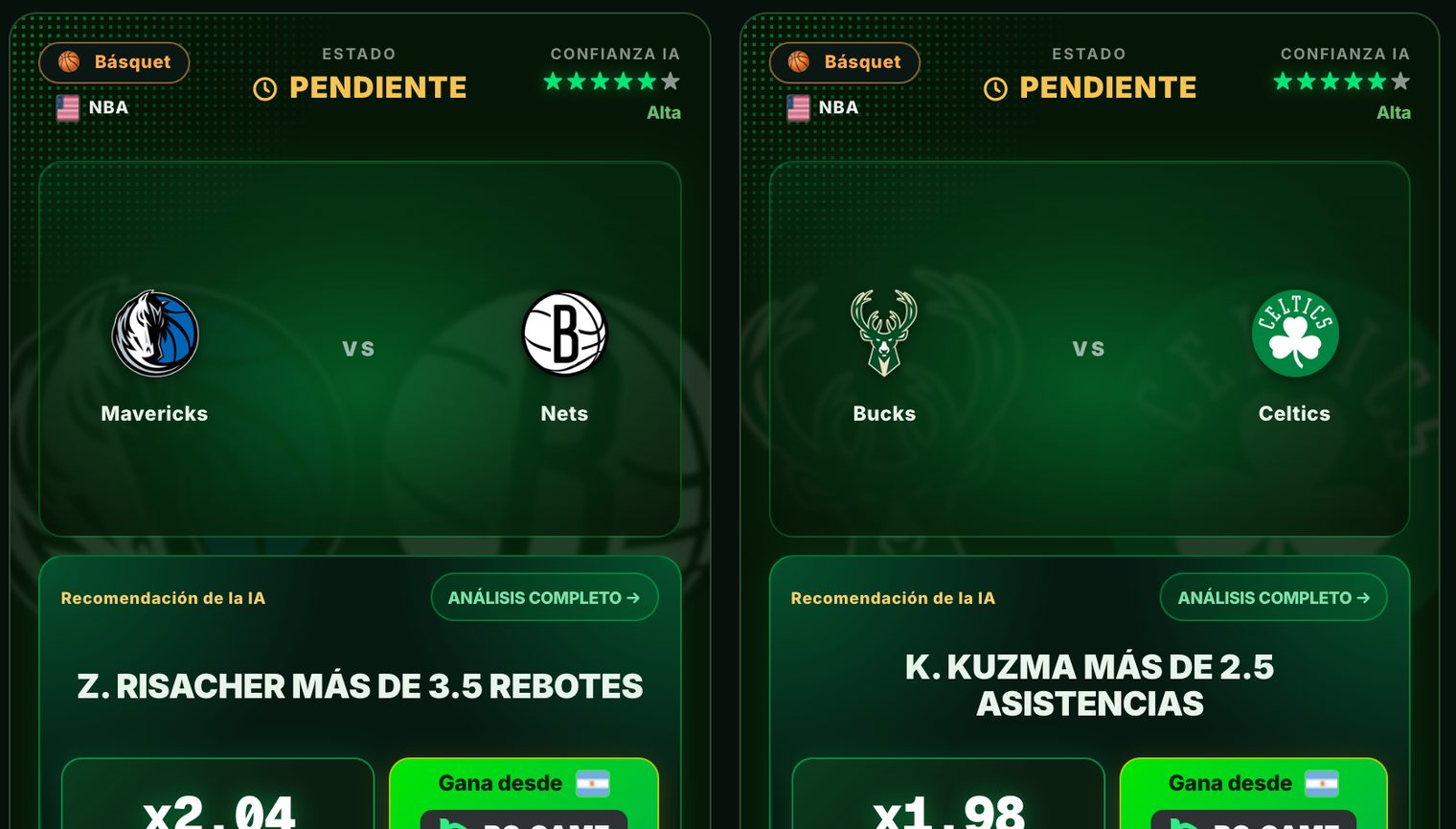
Notice that neither card says how the game ends.
It says what has to happen, with how much confidence and at what price.
This is what you will find on each one:
- Status. “Pending” before the game, then “Won” or “Lost”. The status changes only when the game ends and is never deleted.
- AI confidence. Stars from 1 to 6. Both cards in the screenshot show “High”, five stars out of six. “Maximum” is the top level and it is rare.
- AI recommendation. The actual pick: one player over 3.5 rebounds, another over 2.5 assists. Always a condition that either happens or does not, never an exact score.
- Odds. The price it was published at, x2.04 and x1.98 in the screenshot. With the odds you can work out the implied probability and compare it with the model's estimate.
- Full analysis. The button opens the preview with the data behind the pick: form, absences, market history and charts.
Odds of x2.04 imply a 49% probability.
If the model estimates more than that, the pick has value.
If it estimates less, it is not published, even when the favourite looks obvious.
What do you do with the urge to know the exact result?
The urge is real and a table does not make it go away.
What you can do is turn it into a three-step rule.
Tick each one and your progress is saved in your browser.
If what you want is a free pick every day, without paying anything, read what a free prediction bot can and cannot give you.
The three-step rule applies just the same: no bot publishes correct scores with a real edge.
What does the public record really say?
A site that sells “safe” correct scores shows you screenshots of winners.
A serious site shows you everything, losses included.
This is what Gambeta's record showed at the time of writing.
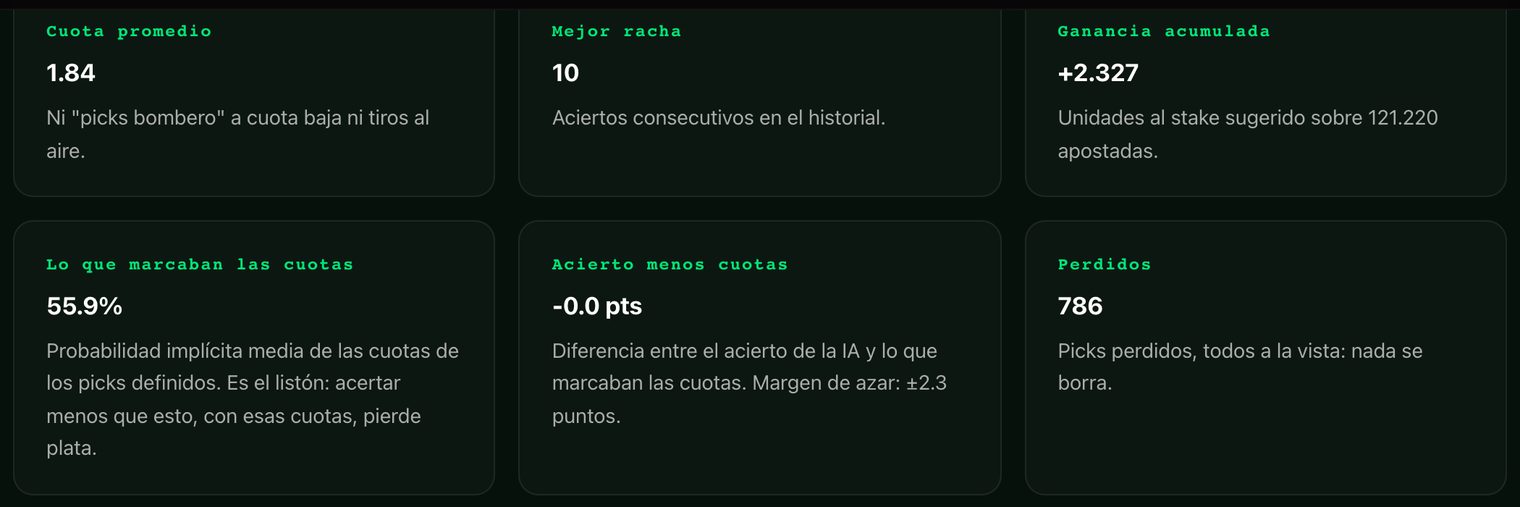
The average odds are 1.84.
No picks at 1.10 to inflate the hit rate, and no shots in the dark at 9.00.
The odds on settled picks implied a 55.9% probability, and that is the bar: hitting less than that, at those odds, loses money.
The “Hit rate minus odds” card says −0.0 points, with a luck margin of ±2.3.
It means that, so far, the AI hits roughly what the odds implied, neither much more nor much less.
The cumulative profit is +2,327 units on 121,220 staked, less than 2% of the amount bet.
It is a modest number and it is in plain sight, which is exactly the point.
And then there are the 786 losses.
None gets deleted, each one has its date, its odds and its result.
If a score prediction site does not let you count its losses, it does not have a record, it has advertising.
To know what else to demand from it, read how to recognise a reliable prediction site.
You can browse the public record pick by pick and download the data to run your own numbers.
A sample of more than 1,800 picks already says something; a hundred correct score picks would say nothing.
So what do I ask the AI for instead of the correct score?
Ask it for a probability, not a result.
Ask it for the market where that probability has value against the odds: match winner, goals, both teams to score or a player prop.
Ask it to publish before the game and to leave the pick in a record you can check.
That is what Gambeta's AI does, and we explain it in full in the guide to AI for betting.
The correct score is for whoever plays for fun, with money they can lose and knowing that odds of 9.00 hide an 8%.
The urge to know the result does not go away, but now you have a rule so it does not decide for you.
Frequently asked questions
Can an AI predict the correct score of a match?
It can estimate the probability of each score, but it does not know which one will happen.
In a typical match, the most likely result has between 8% and 13% probability.
That means even the best model misses the correct score in almost 9 out of 10 matches.
How likely is the most probable correct score?
Between 8% and 13% in most football matches.
In an even, low-scoring match, 1-1 or 1-0 sit around 11-12%.
With a heavy favourite, 2-0 or 3-0 can climb a little, but they rarely go past 20%.
Why does Gambeta not publish a correct score prediction?
Because the edge you would need to beat that market's margin is huge and does not hold up.
The AI publishes markets where the pick's probability sits around 50%: match winner, goals, both teams to score and player props.
Every pick comes out with probability, odds and a confidence level, and stays in the public record.
Is there a 100% safe correct score prediction or one with guaranteed profit?
No.
A score with 12% probability misses 88% of the time, no matter how often the word “safe” sits next to it.
Anyone who promises a guaranteed correct score is selling something, not predicting.
What does the AI publish instead of the correct score?
Match winner or 1X2, over or under 2.5 goals, both teams to score and player props in the NBA, NFL and MLB.
They are markets with two or three outcomes, with average odds of 1.84 in the public record.
There, a well-estimated probability can actually beat the price.
How accurate is Gambeta's AI according to its public record?
At the time of writing, the average odds are 1.84 and the odds implied a 55.9% probability on settled picks.
The AI's hit rate is in line with that bar, with a luck margin of ±2.3 points.
There are 786 losing picks in plain sight and a cumulative profit of +2,327 units on 121,220 staked.
🌍 GLOBALFrom any country · Telegram with a translator into your language
📲 The AI's picks, free on your phone
Every new pick arrives the moment it's made, with a link to its analysis. Choose where to get it:
How each one works: Free AI betting channel on Telegram · Free WhatsApp betting tips channel · Betting channel: Telegram or WhatsApp?